System architecture
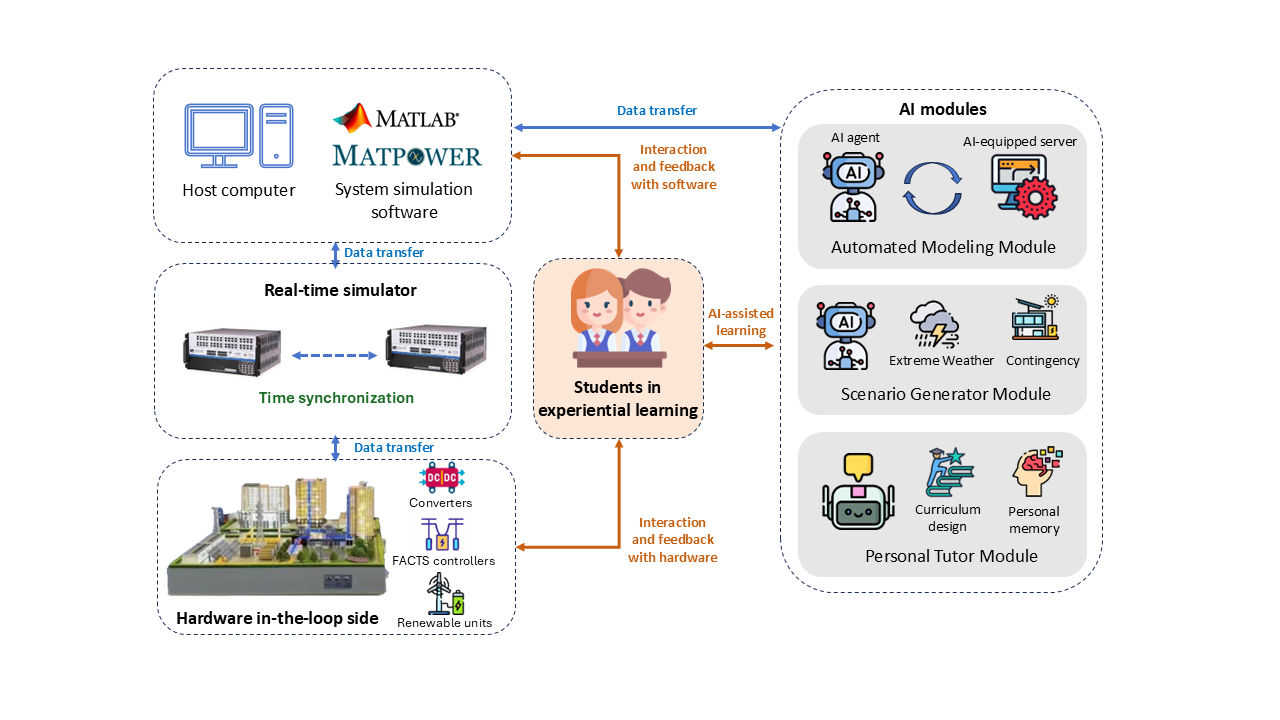
The teaching setup brings real-time simulation, physical equipment, and AI learning support together.
Platform modules
Hardware-in-the-Loop
Follow signals between physical equipment and the real-time model.
AI Experiment Assistant
See where prompts, feedback, and scenario guidance fit into a lab.
Innovation Hub
Plan a student comparison of two approaches to renewable energy.
Energy & Carbon Explorer
Work through a short energy balance and emissions example.
From scenario to evidence
Run a scenario
Set up a change in the simulated energy system, such as a drop in solar generation.
Read the hardware
Observe how the connected equipment responds and compare measurements against your prediction.
Explain the result
Use the planned AI tutor for prompts and feedback, then support your explanation with the experiment data.
Inside the proposed system
A host computer supplies the system model. The real-time simulator exchanges signals with physical equipment such as converters, controllers, and renewable energy units. Students interact with the simulation and hardware, then use the measurements to explain what changed.
Where AI supports learning
- Model setup. An automated modelling module is planned to help prepare scenarios for experimentation.
- Scenario design. A scenario generator is designed to suggest cases such as extreme weather or equipment contingencies.
- Feedback. The planned tutor can prompt students to check their assumptions, interpret observations, and explain the result in their own words.